
attendo CMMS
The CMMS that also knows who your customer is
Assets, preventive maintenance, work orders, spare parts and cost per asset. All connected to the service request that reported the breakdown, the contract that covers it and the technician who fixes it.
- We import your inventory from Excel
- A QR code on every asset
- AI that prioritizes breakdowns, if you turn it on
If this sounds familiar, keep reading
Preventive maintenance is the first thing to slip
You plan it in January. In February an urgent breakdown comes in and one inspection gets moved. In March, three. By June there is no plan left: just a list of things you keep carrying over.
And the customer asks whether the April inspection was done. The answer is in a technician’s head, or on a paper service report inside a van.
- Report missing
You cannot prove what you did
The service report arrives late, incomplete or not at all. Without evidence, you lose the argument with the customer.
- Inspection overdue
You live in corrective mode
Every emergency eats up a planned inspection. Preventive maintenance is not a priority until the machine stops.
- No cost assigned
You do not know which asset is costing you money
You have a hunch, but you cannot back up a replacement with data in front of management.
- Location unknown
The inventory has ghosts
Equipment that was moved, retired or listed twice. And that undermines trust in everything else.
Who it is for
For maintenance teams, with their own assets or their customers’
For teams that maintain their own plants, buildings or sites, and for companies that maintain their customers’ equipment under contract. It works in any industry and any country: these are the most common.
Are your assets spread across several sites, each with its own requests and suppliers? See Facility Management.
Industries
Types of business
- Companies that maintain their customers’ assets
- Organizations that maintain their own assets
- Public administrations and agencies
How it works
From breakdown to asset history, with no gaps
Six steps, one document. What happens to the equipment stays on the equipment’s record.
- Step 1
The service request comes in
By email, portal, phone or by scanning the QR code on the equipment itself, with no username or password. It arrives with the customer and the asset already identified.
- Step 2
The work order is created
From the service request, from the asset record or from the preventive maintenance plan. With technician, tasks, checklist, dates and planned materials.
- Step 3
The technician opens it in the app
With the equipment history in front of them: they read what was done last time before they get out of the van.
- Step 4
Documents it on site
Ticks off tasks, fills in the checklist, takes the photos, logs the spare parts used and starts the timer.
- Step 5
Closes with a signature
The customer signs on the screen. The service report goes out as a PDF with your branding, right away.
- Step 6
It stays in the asset history
With date, technician, hours, materials and cost. The next breakdown starts with the diagnosis half done.
The equipment history gives the next ticket a head start
01 A ticket comes in Through the equipment QR code, email or the portal, with the asset and the customer already filled in.
02 marIA suggests a diagnosis Symptoms, likely cause and criticality on the record. The person in charge accepts or corrects it.
03 It gets scheduled It moves to the board with its technician, its date and the planned spare part.
04 Work on the equipment Checklist, photos, hours and materials from the phone, online or offline.
05 Closed with data Downtime, hours and spare parts stay on the work order and on the asset record.
06 Added to the history Next time it fails, whoever opens the ticket sees everything that came before.
07 Waiting for materials A status of your own: the work order waits for the part and stays in sight.
08 Pending sign-off Another custom status: someone at the plant signs off before it closes.
Add a status of your own and see where it fits in the workflow.
Each document type can have its own statuses, with no coding.
The next work order comes from the same plan
01 The plan creates the work order Each work order is created on its date, with a window to bring it forward or push it back.
02 Assigned on the schedule Each technician sees their jobs for the day, with the equipment and how to get there.
03 Checklist at the equipment Readings with their range, and a required photo where needed.
04 Findings don’t get lost What the inspection finds becomes a scheduled corrective job, with a date.
05 Plan vs. reality Plan tracking flags when the work done doesn’t match the plan, and fixes it without duplicates.
The equipment trend stays in view
01 Readings come in The equipment sensors send their values, and they are stored on its record.
02 marIA spots the trend It warns you before the breakdown and says what it is based on. A person decides.
03 The work order opens With the reading that triggered it inside, so the technician has it right there.
04 Fixed during downtime The job fits into a planned shutdown.
05 It stays on the record Alert, work order and readings stay together in the asset history.
With your data
See it with your own inventory
In the demo we walk through this workflow with a sample of your assets and one of your preventive maintenance plans, not a generic example.
Assets
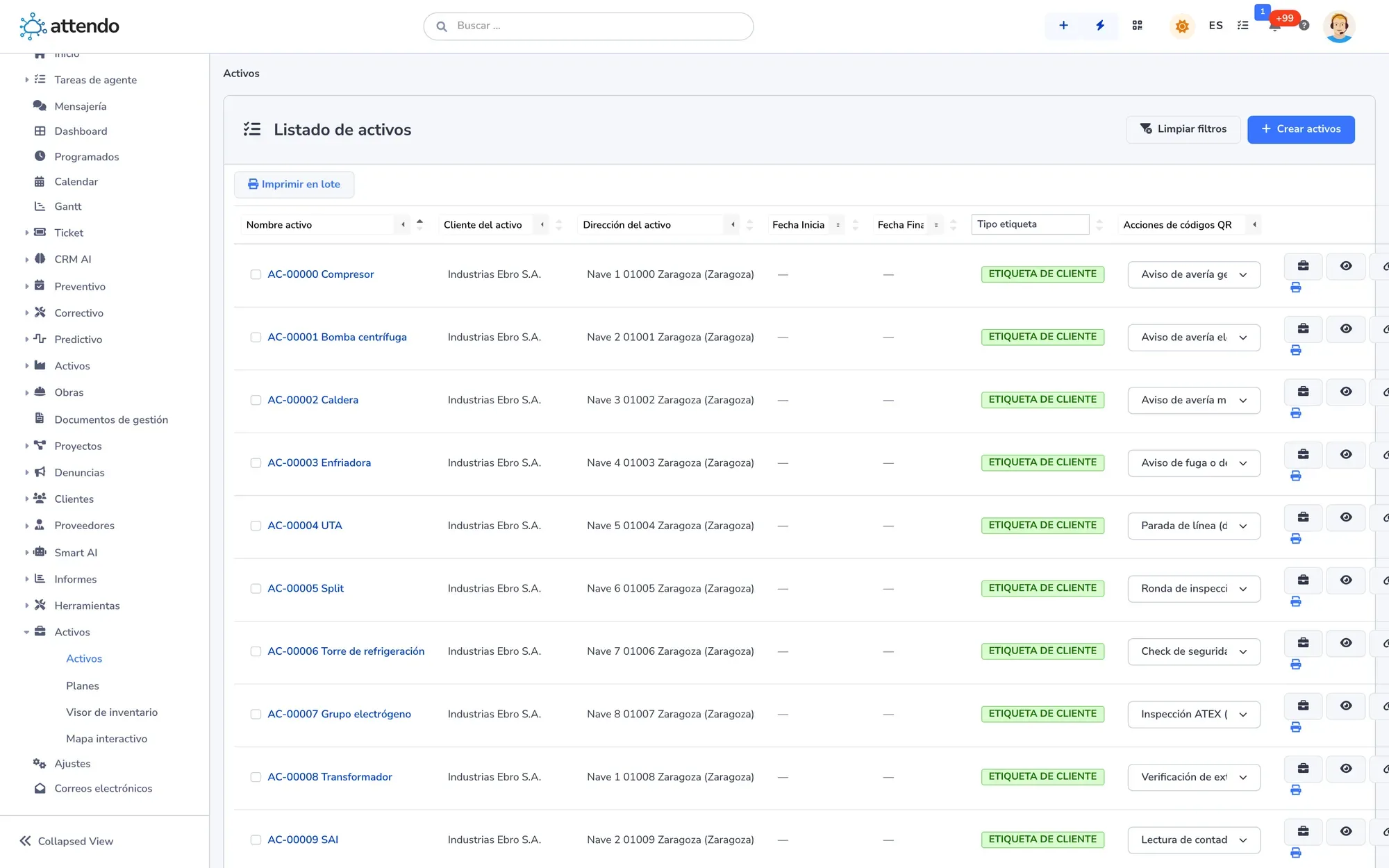
Every machine, with its own ID
Every piece of equipment has its record: family, exact location, owning customer, brand, model, serial number and warranty. Plus the technical fields you need, with their range and threshold.
The QR code stuck on the equipment is what keeps the inventory alive: whoever is standing in front of it scans it and opens its record or a service request.
- Full hierarchy: customer, building, floor, room and equipment
- Asset families with their own fields, and cloning an asset to another customer
- Several QR codes and barcodes per asset. You print only the missing ones, on label sheets
- Folders by floor, line or group of machines, with their floor plan (image or PDF) and each asset placed on it
- With GIS inventory, the folder is a map: OpenStreetMap, or HERE with your key, with GeoJSON in and out and WMS or WMTS layers
- Alert before an asset’s warranty expires
- Import of assets, QR codes and barcodes, checklists and plans, with the file checked in full before anything is saved
Preventive maintenance
So the plan stops being a good intention
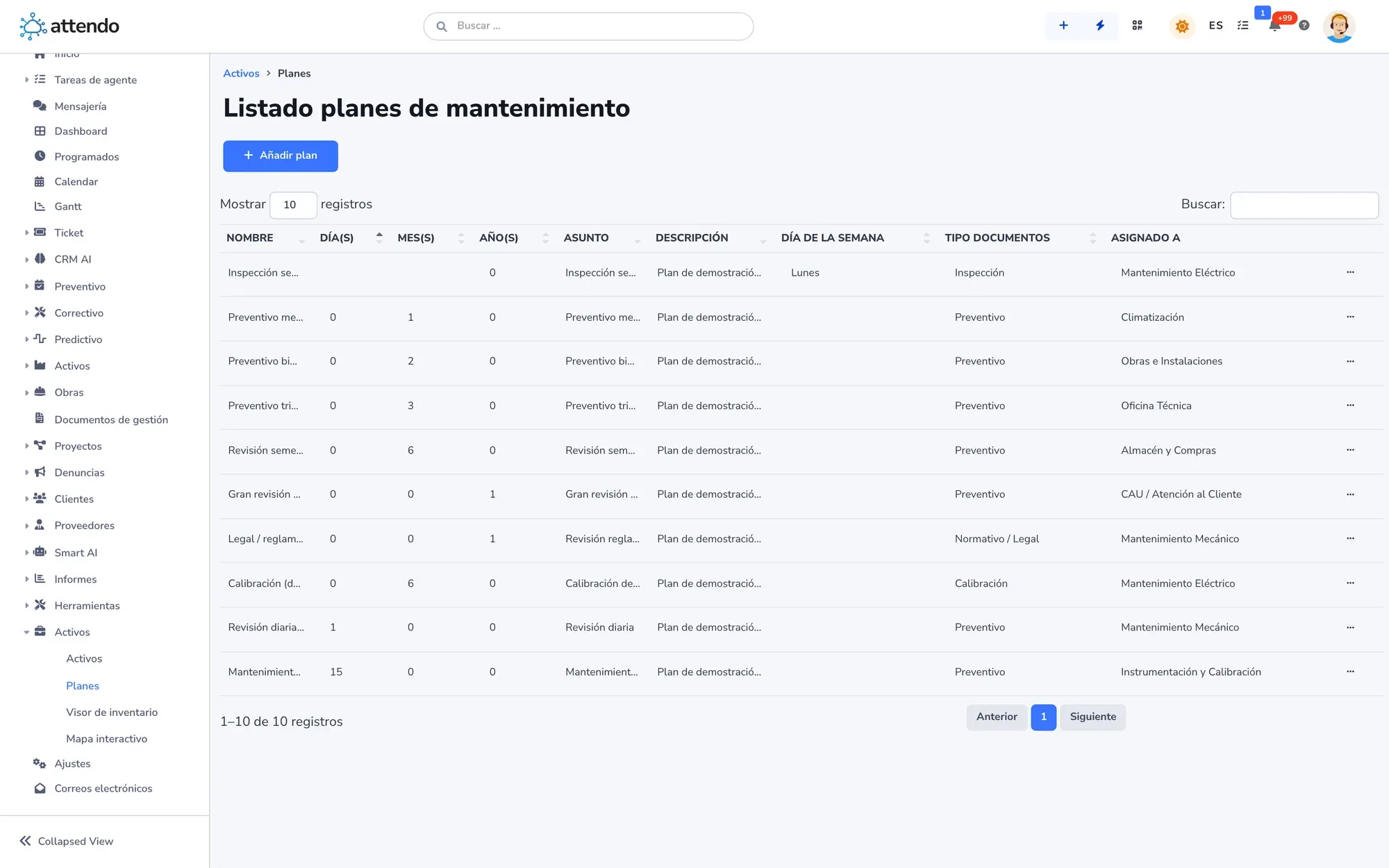
You define plans per asset, per family or per customer, with their checklists and planned materials. attendo generates the work orders on your business calendar and puts them in the right person’s queue.
When an inspection spots an anomaly, it becomes planned corrective maintenance, before it turns into a breakdown on a Friday afternoon.
The awkward question in any auditDoes every asset have the work orders its plan promises? attendo checks each work order against its plan when it creates it, and a supervision pass checks the upcoming ones again. Plan tracking shows each plan’s status with a colored dot, explains what each work order is missing and keeps a history you can show.
- Three generation modes: the full year, rolling windows (plan three years ahead without freezing anything) or when the previous inspection closes
- Execution window: how many days an inspection can move without a breach
- Bulk assignment of a plan to hundreds of assets, with customer and contract per asset
- Each work order is checked against its plan when it is created (tasks, checklist, materials and assignment) and anything missing is filled in
- If you subcontract, the subcontractor accepts or declines each work order in its portal and proposes a date, within the plan’s window
- Alerts for overdue plans and open work orders, ready to switch on
- Compliance · My team: the prioritized list of what could be breached, with the team’s overdue tasks
Work orders
The work order a technician understands without calling you
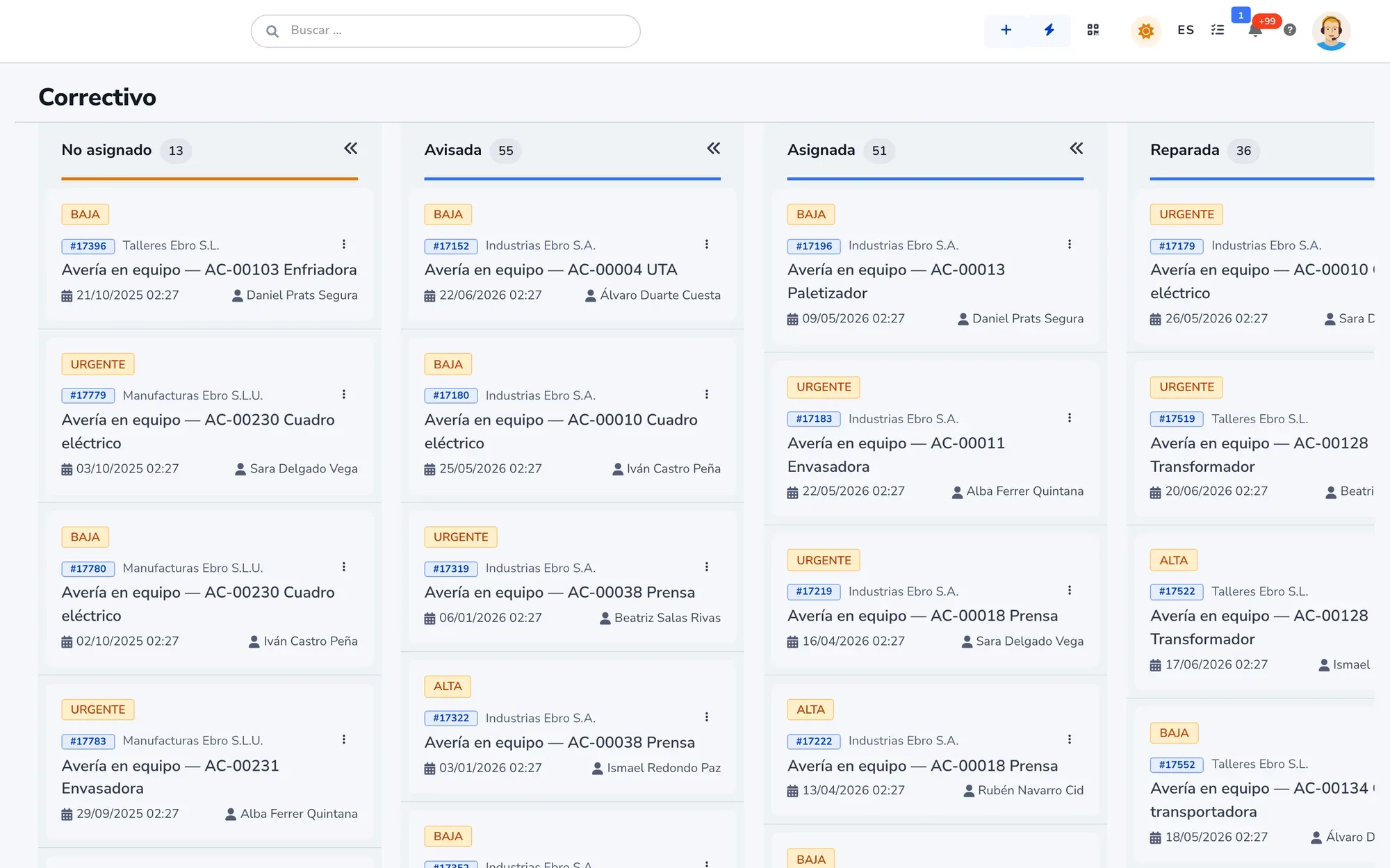
Corrective, preventive and predictive, each with its own workflow and on the same asset. Predictive maintenance works with AI models on the readings from your sensors and IoT. Tasks by phase, templates that fill in the usual, planned materials and the equipment history one tap away.
The better the work order is described, the fewer calls afterwards.
- Custom statuses: waiting for parts, pending validation, billable…
- Child work orders, plus downtime type and duration for the equipment
- Hours timer, expenses and supplier on the same work order
- Kanban board to hand out the work at a glance
- Each technician sees only their area or plant, and claims what they are going to do
Spare parts
From forecast to purchase order, without Excel
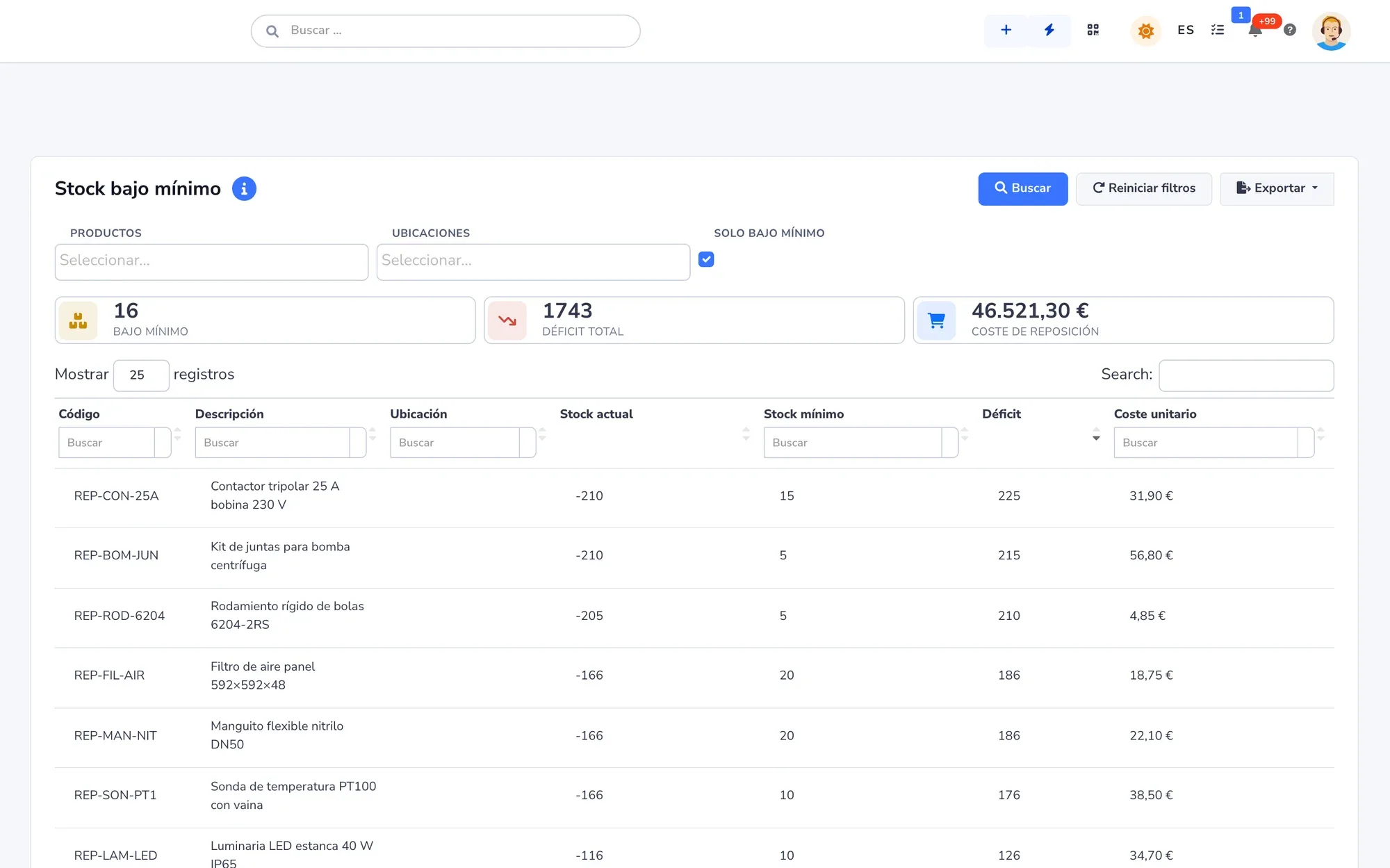
Stock per warehouse, including the van, with minimums, transfers and counts. Only confirmed consumption reduces stock, and every part is charged to the equipment where it was fitted and to the technician who used it.
- 90-day shortfall forecast based on your plans
- Purchase order generator: one per supplier, emailed with its PDF
- Part numbers from your ERP that do not overwrite your internal code
- Alert when stock drops below the minimum
Costs
What it really costs to maintain each asset
Hours, spare parts, travel and expenses add up on each asset. After a year you have what no spreadsheet gives you: the real cost per asset, per family and per customer.
It is the argument you need to justify a replacement or renegotiate a contract that has fallen short.
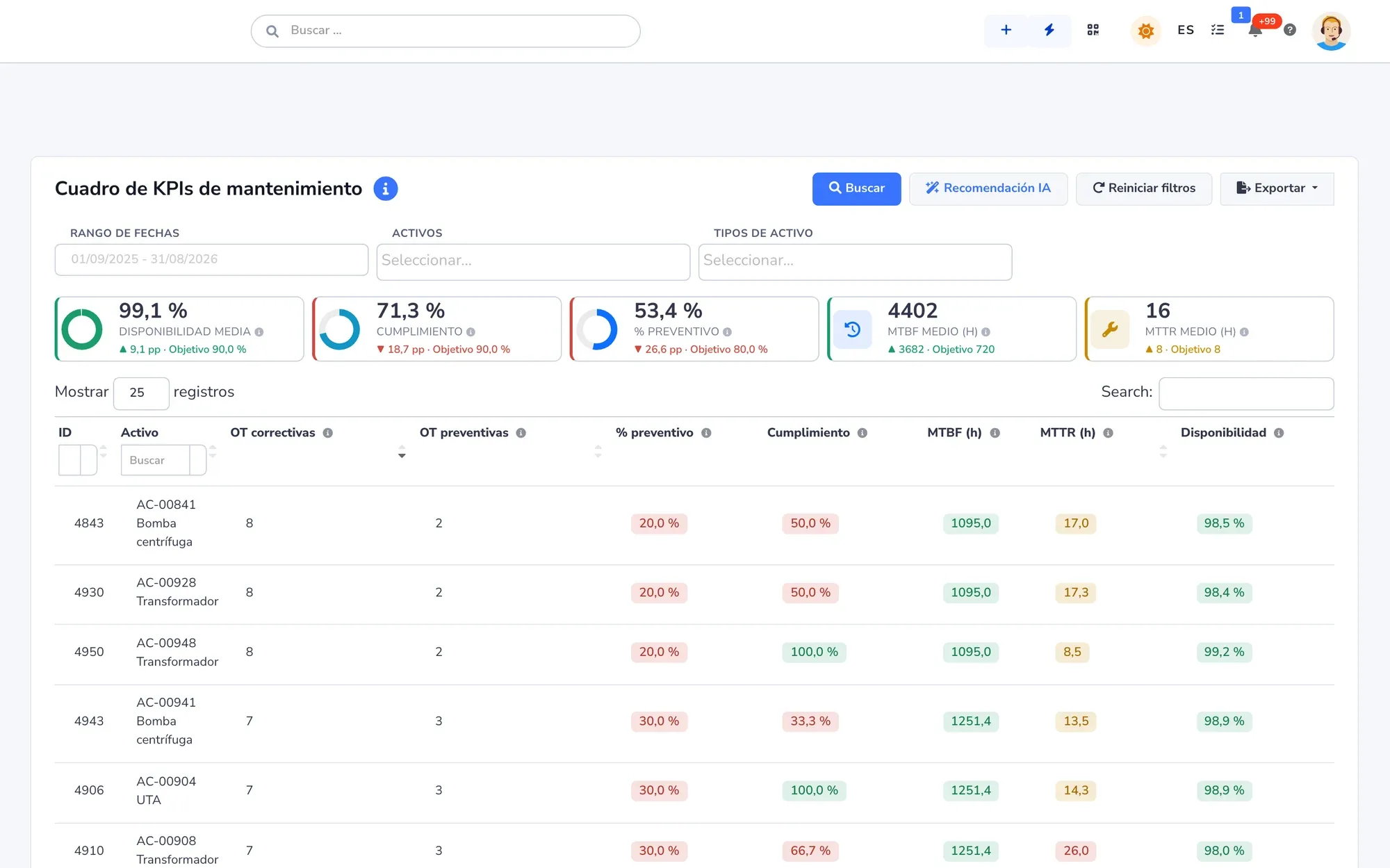
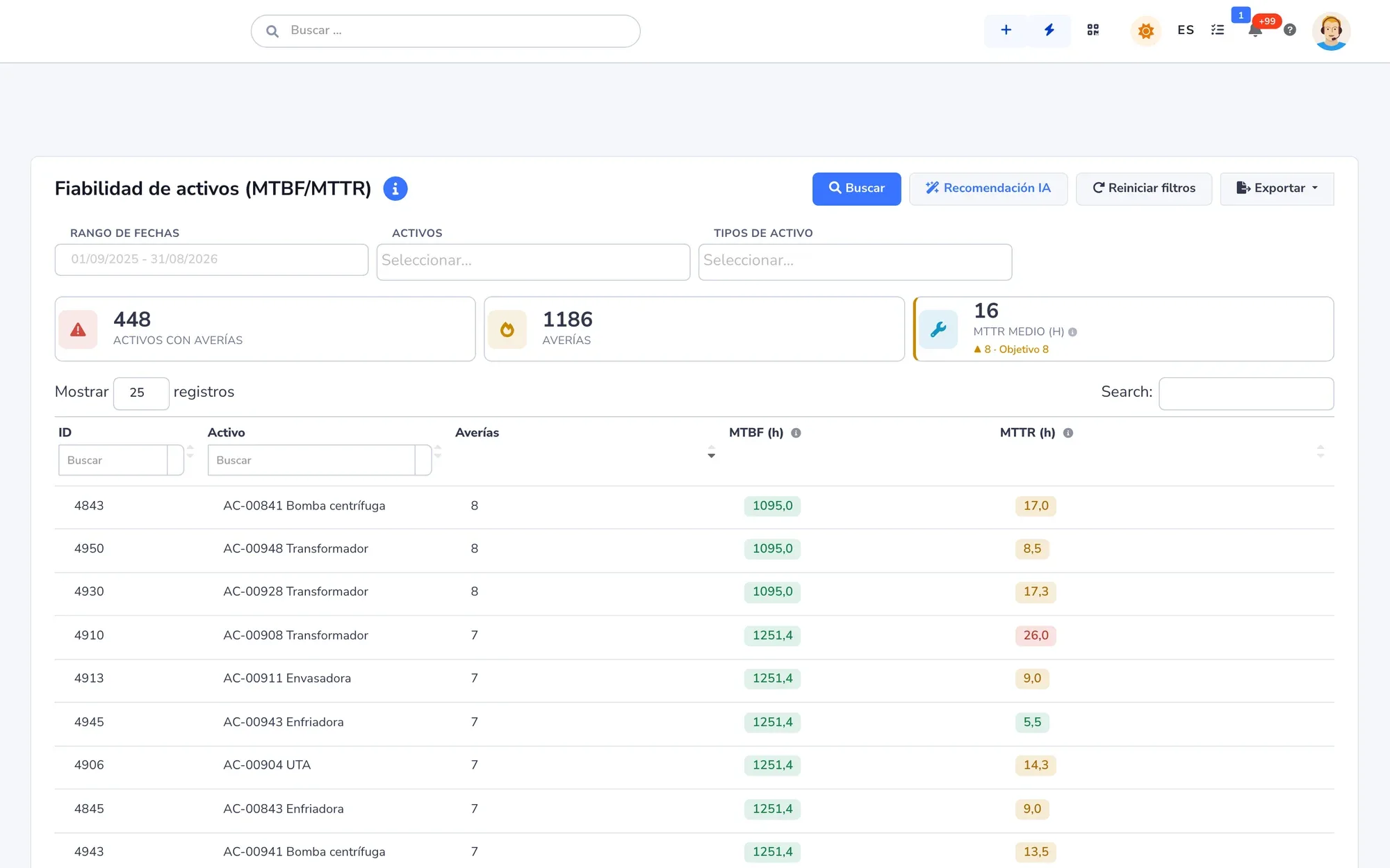
- 22 maintenance KPIs, such as MTBF, MTTR, availability, backlog or OEE, each with its target, its formula and its traffic light
- Corrective versus preventive, and plan compliance customer by customer
- Cost per asset, spare parts consumption and each technician’s workload
- Costs tab on any tag: a line or a floor adds up everything below it, at every level, with taxes and hours by category
- Reports and an attendo CMMS dashboard you can edit, with export and scheduled email delivery
Projects and shutdowns
Major shutdowns, run as a project
A plant shutdown or a replacement project is managed with a Gantt chart, a baseline and cost tracking as it happens. You can import the budget in BC3 format.
Industry requirements
What an audit asks for, already on the record
| Requirement | How attendo covers it |
|---|---|
| Evidence of every inspection | Checklist with photo, time, geolocation, signature, template version and lock on close. The PDF comes out the same on mobile and on desktop |
| Proving the plan is being met | Plan tracking with history and a compliance report per customer |
| Facility regulations (HVAC, fire protection, low voltage, elevators) | attendo does not come with regulations preloaded. You set them up with your responsible technician as plans and checklists, with their frequencies |
| Report to the customer after the visit | Signed service report and checklist with your design. You define the report format |
| Spare parts traceability | Confirmed consumption per asset and per technician, with your ERP part number |
| Maintenance contracts | Scope, SLA and an hour bank that draws down automatically, with profitability per contract and per building |
| Equipment warranties | Warranty end date on the record and an expiry report |
marIA in the CMMS
The overnight breakdown, prioritized by 9 AM
-
Prioritizes breakdowns
On each corrective work order, marIA proposes a likely diagnosis and a criticality score from 0 to 100. It weighs asset criticality, impact, SLA, status and recurrence. A person reviews and decides.
-
Answers questions about your data
“Which assets had the most breakdowns this quarter?” In plain language, read-only, and showing where the answer comes from.
-
Writes down what the technician says
The voice note recorded in the van ends up summarized on the work order, without anyone typing it up.
-
Searches your manuals
It answers citing the equipment documentation.
What it does not do: assign, repair or close work orders. Without AI, the CMMS works in full.
AI Autopilot (Multiple AI Agents) · maintenance example
A corrective work order enters the AI Autopilot process. marIA suggests a likely diagnosis, assesses the risk and recalculates the priority; the maintenance manager approves the job.
-
01 Diagnosis marIA · Diagnoses
New WO-2026-0142 Pump BP-02 · vibration- Symptoms
- Cause
- Action
Cause likely
-
02 Risk marIA · Assesses
Diagnosis What drives criticality- Impact · High
- SLA risk · Medium
- Recurrence · Low
Criticality high
-
03 Prioritization marIA · Prioritizes
Diagnosis Criticality score 82/100 With the reason for the changePriority adjusted
-
04 Human review Person
Waiting for you Maintenance manager Pending approvalAgents paused
Integrations
Connected to what you already use
The hours and materials on each work order go to your connected ERP, which issues the invoice: attendo is not an ERP or accounting software. The connector with your ERP is native and is tested first in your test environment. Service requests come in by email, portal or WhatsApp.
Do you have sensors or a building management system? Sensors and IoT connect natively, and everything else comes in via API or webhook. When a reading goes out of range, the work order opens.
And if you work with a GIS, the mapped inventory goes in and out as GeoJSON. It also reads WFS layers and publishes the inventory for QGIS or ArcGIS.
Honest comparison
Where it fits (and where it does not)
We would rather you know now than at the third meeting.
| If your priority is… | attendo CMMS |
|---|---|
| Maintaining your customers’ assets, with contracts, SLAs and quotes for what is not covered | attendo CMMSThis is its home turf. It wins here |
| Maintaining your own assets with plans, spare parts and costs | attendo CMMSIt competes head to head, with field service and support already built in |
| A reliability team in heavy industry, on SAP PM | attendo CMMSYour ERP is the better choice. attendo can take care of the technician and leave the accounting entries to SAP |
| Spatial analysis of your network, as in a GIS | attendo CMMSYou keep doing it in your GIS. attendo places assets on the map and exchanges the inventory with it |
Detailed comparisons: attendo vs. Fracttal, vs. Infraspeak, best CMMS software 2026. See all.
Calculate with your own numbers how much breakdowns cost you compared with preventive maintenance.
The rest of the platform
The rest of the platform, when you need it
Modules used by attendo CMMS
- marIA (Smart-AI)
- Flows and AI-Flows
- AI Autopilot (Multiple AI Agents)
- AI-Chat and DB Assistant
- AI-CMMS
- Timeline
- Tags and document management
- Business documents
- attendo Checklist
- attendo Forms
- attendo Tasks
- Compliance · My team
- Kanban
- Gantt chart
- Scheduling and calendar
- Communications
- Web quotes
- ERP integration
- Reports and dashboards
- Assets and inventory
- Contracts and SLA
- Customer, supplier and partner portals
- Web chatbot
- Telephony
- Projects and construction
- Time tracking
- Mobile app and Field Radar
- Warehouse, purchasing and stock
- Print designer
- API v4, webhooks and MCP
After you request a demo
What happens when you get in touch
A real person from our team replies, and we prepare the demo around your case. No cold calls afterwards.
When we reply
Our hours: Monday to Thursday 9:30 AM to 6:30 PM and Friday 9:30 AM to 2:30 PM, Spain time.
We have emailed you a confirmation that your request arrived. If you do not see it in a few minutes, check your spam folder.
- Today
You tell us about your case
What you want to solve, how many people would use it and what you work with now.
- Next
We agree on a time
We write to you to schedule the demo and, if you like, to ask for a sample of your data: an extract of your asset inventory in Excel or CSV and one of your preventive maintenance plans.
- In the demo
You see attendo with your own setup
Your document types, your assets and your customers. And we tell you what fits and what does not.
Frequently asked questions
Frequently asked questions
What is a CMMS?
CMMS stands for computerized maintenance management system: the software that organizes assets, preventive maintenance plans, work orders and spare parts. attendo CMMS is exactly that, on the same platform as your CRM and your field service.
Can we import our current inventory?
Yes. Assets with their fields, families, locations, customers, QR codes and barcodes, checklists, spare parts and even the plans and which assets they are assigned to, from Excel or CSV. The file is checked in full before anything is saved, and errors are listed row by row. The demo is prepared with your real inventory.
We had a CMMS before and went back to Excel because nobody filled it in. What is different?
The technician does not “fill in the CMMS”: they scan the QR code, look, tick and sign. That is fewer steps than the paper service report. If the point of capture is not where the work happens, no CMMS works.
Does it work offline?
Yes, with the attendo app for iOS and Android: technicians take their work orders with them, work with no signal and everything syncs when the signal comes back. In the browser, you need a connection.
Is it for industrial maintenance or only for buildings?
Both. Asset families and custom fields adapt to HVAC, elevators, water treatment, solar PV or production machinery. Major shutdowns are run as projects.
Can it generate thousands of preventive work orders without choking?
Yes. Generation runs in the background, and one plan can be assigned to hundreds of assets at once.
Does it connect to sensors or SCADA?
Yes. Sensors and IoT connect natively, and an out-of-range reading opens the work order. Other systems come in via API or webhook.
Which maintenance KPIs does it include?
22, in the KPI tab of the maintenance dashboard: MTBF, MTTR, MTTA, availability, backlog in weeks, preventive compliance, OEE with its three factors, first-time fix rate… Each with its target, its formula and a traffic light. They follow the dashboard filters: customer, asset type, line, criticality and dates.
Can we see the inventory on a map or take it to our GIS?
Yes, with GIS inventory: a folder can be a map, from OpenStreetMap or from HERE with your key, with assets as points, lines or areas. It imports and exports GeoJSON (ETRS89 UTM or Web Mercator) and adds WMS or WMTS layers. It also reads WFS layers, and QGIS or ArcGIS can read the inventory directly.
Can customers see the status of their equipment?
Yes. In their portal they check their service requests, their inspections and the signed service reports, without calling you. If you turn it on, they also see their equipment with its warranty and next preventive visit, report a breakdown from there and view the floor plans and maps of their locations, with their own items only.
Request a demo
Set it up with your assets, not with examples
Give us your inventory and we will show you attendo with your equipment families, your inspection plans and your technicians. Try it with your own data before you decide.
- With your operation, not a generic demo
- A real person from our team replies
- No cold calls afterwards
Would you rather talk first?
- Phone +34 902 750 677 · +34 910 053 530
- Email sales@attendo.me
- Monday to Thursday 9:30 AM to 6:30 PM and Friday 9:30 AM to 2:30 PM (Spain time)