
Located, with an owner
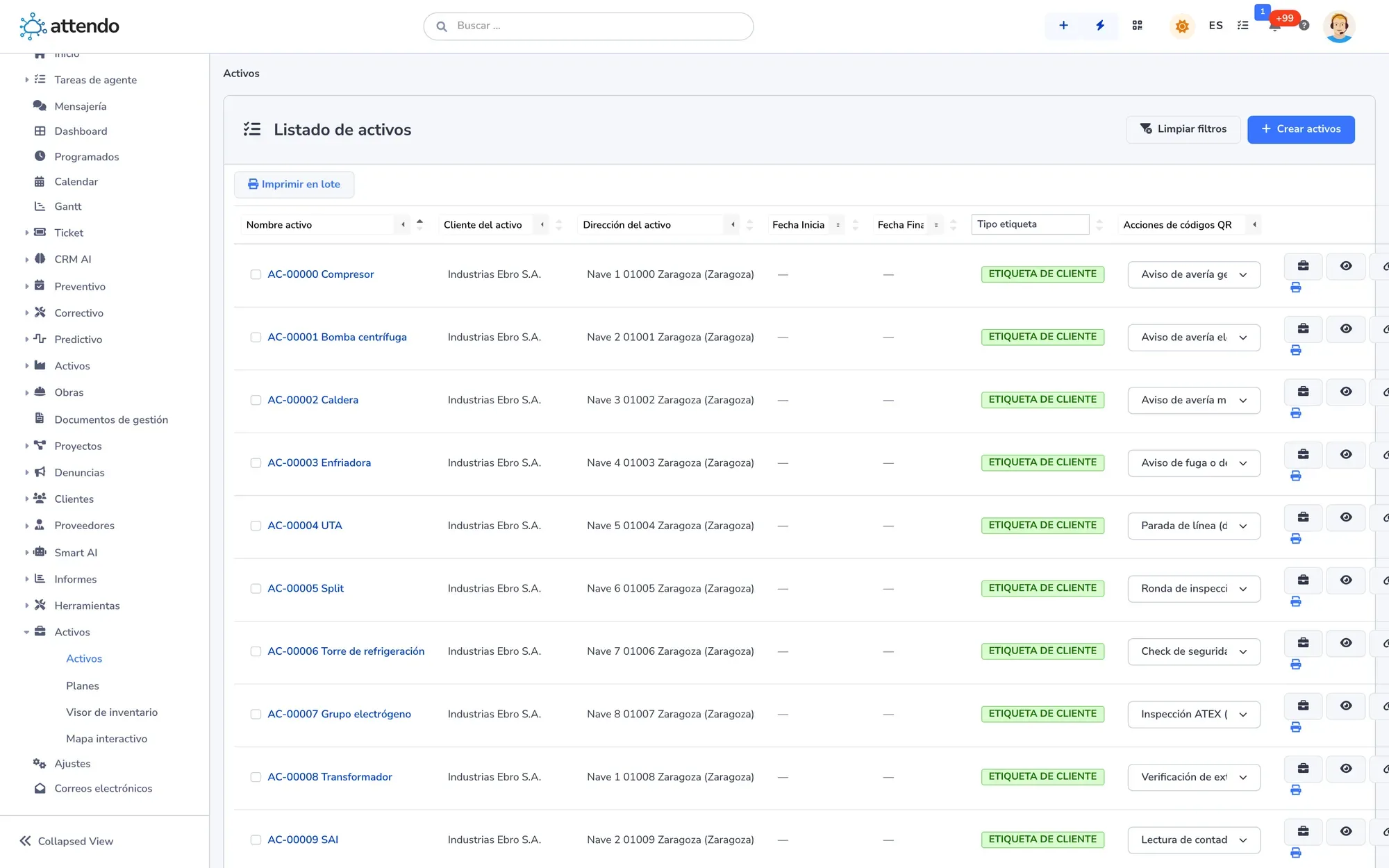
Each asset belongs to its customer and its site: building, floor and room. You search by building instead of scrolling through thousands of rows, and the work order inherits the customer, the contract and the equipment.
Choose which cookies you accept. You can change this at any time from “Cookie settings” in the footer of every page. Cookie policy
They make the website work, remember this choice, keep your conversation with the assistant if you use it, and protect the forms from bots. They cannot be turned off.
During your visit we remember the campaign source you arrived with and the page you landed on, so we know which campaigns and pages bring us requests. Cloudflare Web Analytics counts visits without cookies and does not depend on this option.
Used to measure our campaigns on Google Ads, LinkedIn and Meta. None is active on the website today.
Assets and inventory
Each asset belongs to a customer, with its location, technical fields and QR code. Whoever is on site opens a ticket without logging in, and the technician reads the history before touching anything.
Report an issue
Send Ticket TK-2490 createdWork and planning
Each asset belongs to its customer and its site: building, floor and room. You search by building instead of scrolling through thousands of rows, and the work order inherits the customer, the contract and the equipment.
Each piece of equipment carries its QR codes and barcodes. Scanning one opens its record or the form you choose: breakdown report, inspection round or meter reading. Labels print on adhesive sheets.
You organize assets into families, each with its own technical fields: refrigerant, pressure or warranty end date. A template is reused across customers, and a complete asset can be cloned to another customer with its fields and tasks.
Technical fields have a range and a threshold, and every inspection saves its readings. Sensors and IoT devices connect natively: an out-of-range reading opens a work order with its asset and priority.
The record brings together the plans, work orders, installed spare parts, costs and the equipment map. Before touching anything, the technician reads what was done last time and what the previous colleague recommended.
Floors, lines and groups of machines are organized in folders, each with its floor plan and the assets placed on it. With GIS inventory, the folder is a map, with GeoJSON in and out and WMS or WMTS layers.
How it works
From Excel or CSV, with the file checked in full before anything is saved and errors listed row by row. Customers first, then assets.
You print labels in batches, filtered by folder or field, without repeating the ones you already printed.
A preventive maintenance plan for one asset or hundreds at once, each with its customer and contract.
Every ticket, work order, reading and spare part stays on its record, and the cost per asset shows up in the reports.
With AI-CMMS, marIA suggests the likely diagnosis and the criticality of each breakdown, and writes the technician’s voice note into the equipment history. For predictive maintenance, AI models work on the readings from your sensors and IoT devices. Every operation is logged with who ran it, the model and its cost. Spending has the monthly cap you set.
Where it is used
Industry solutions
Honesty
Floor plans and maps are prepared on desktop. On mobile, the technician works with the asset record and its QR code.
It is not a GIS: it places assets and exchanges the inventory as GeoJSON. It also reads WFS layers and publishes the inventory for QGIS or ArcGIS to read.
Works with
Checklist · Safety inspection
Inspections with photo, signature and location, closed on site
See attendo ChecklistReport an issue
Send Ticket TK-2490 createdPublic and QR forms that create the document, no account needed
See attendo FormsCold room 2 compressor won’t start
The AI in attendo CMMS: probable diagnosis and criticality
See AI-CMMSWarehouses, stock, purchasing and suppliers, without a spreadsheet
See Warehouse, purchasing and stockGlossary
Maintenance
An asset is any piece of equipment, machine or installation whose maintenance you keep track of: its record, its location, its history and its costs.
Maintenance
Equipment criticality
Asset criticality is the impact that an asset’s failure has on service, production or safety. It helps you share out a maintenance budget that is always limited.
Maintenance
Mean time between failures
MTBF (mean time between failures) is the average time a piece of equipment runs properly between one breakdown and the next. It measures reliability.
Maintenance
PM
Preventive maintenance is work planned by calendar or by usage to keep failures from happening: routine inspections, lubrication, scheduled replacements and regulatory checks.
Frequently asked questions
Yes. The list is paginated and filtered on the server, and it works with thousands of pieces of equipment. You can also search by building, floor or room.
No. Whoever is on site opens the breakdown form from their phone, with no username or password. The ticket comes in with the asset and the customer already filled in.
Yes, from Excel or CSV: assets with their fields, families, locations, QR codes and barcodes, checklists and plans. The file is checked in full before anything is saved, and errors are listed row by row.
Yes, natively. Readings from your sensors and IoT devices reach the asset, and an out-of-range reading opens a work order with its priority.
Yes, and that is where it fits best. Each asset belongs to its customer, and the work order carries the contract that covers it and what it really costs.
Request a demo
We will show it to you with your own document types and the way you work. If it is not a fit, we will tell you.
Would you rather talk first?