
Facility Management
Every site reports, every supplier responds and you see it all
For companies with offices, plants, stores or buildings spread across locations. Each request arrives with its site and its equipment, and goes to your technician or your supplier with the contract’s SLA.
- Requests by portal, QR code, email or WhatsApp
- Assets by site, building and room
- Suppliers in their own portal
If this sounds familiar, keep reading
Many sites, no complete picture
Each site reports however it can: a call, an email or a message to the technician they know. Each supplier works with its own report and its own PDF.
And when management asks what it costs to maintain each building, someone spends days pulling spreadsheets together.
- Not logged
Requests come in from everywhere
Phone, email and the site manager’s WhatsApp. Nobody knows what is open or who is handling it.
- Location unknown
Each site has its own inventory
In a different spreadsheet, or in the supplier’s head. When you change suppliers, the inventory leaves with them.
- Report pending
Suppliers work blind
They arrive without knowing what was done last time and hand in the report when they can. Nobody measures their SLA.
- Report overdue
Comparing sites is impossible
Each one measures things its own way. The report for management is built by hand, and it arrives late.
Who it is for
For companies and facilities with several sites
For teams that maintain their own buildings and for those who manage them on someone else’s behalf. It works in any industry and any country.
Do you maintain other people’s buildings under contract? See Facility maintenance and services. A network of stores, hotels or restaurants? See Hospitality, retail and multi-site operations.
How it works
From the request to the site report
Six steps. The site, the equipment and the supplier travel with every request.
- Step 1
The site reports it
From the portal, with the QR code on the equipment or in the room, by email or by WhatsApp. The request starts with the site, the location and the equipment.
- Step 2
It is prioritized and assigned
With the contract’s SLA and a priority that marIA can suggest. It goes to your technician or to the right supplier.
- Step 3
It is scheduled
Corrective jobs go on the schedule alongside each site’s preventive maintenance. Field Radar shows which technician is closest.
- Step 4
It is fixed on site
Your technician works in the app, offline too, with checklist, photos and signature. The supplier accepts the job in its portal and closes it with its service report and the customer’s signature.
- Step 5
It is documented
In the history of the equipment and the site: who went, what they did and with what evidence. Manuals and certificates, on the record.
- Step 6
It is measured by site
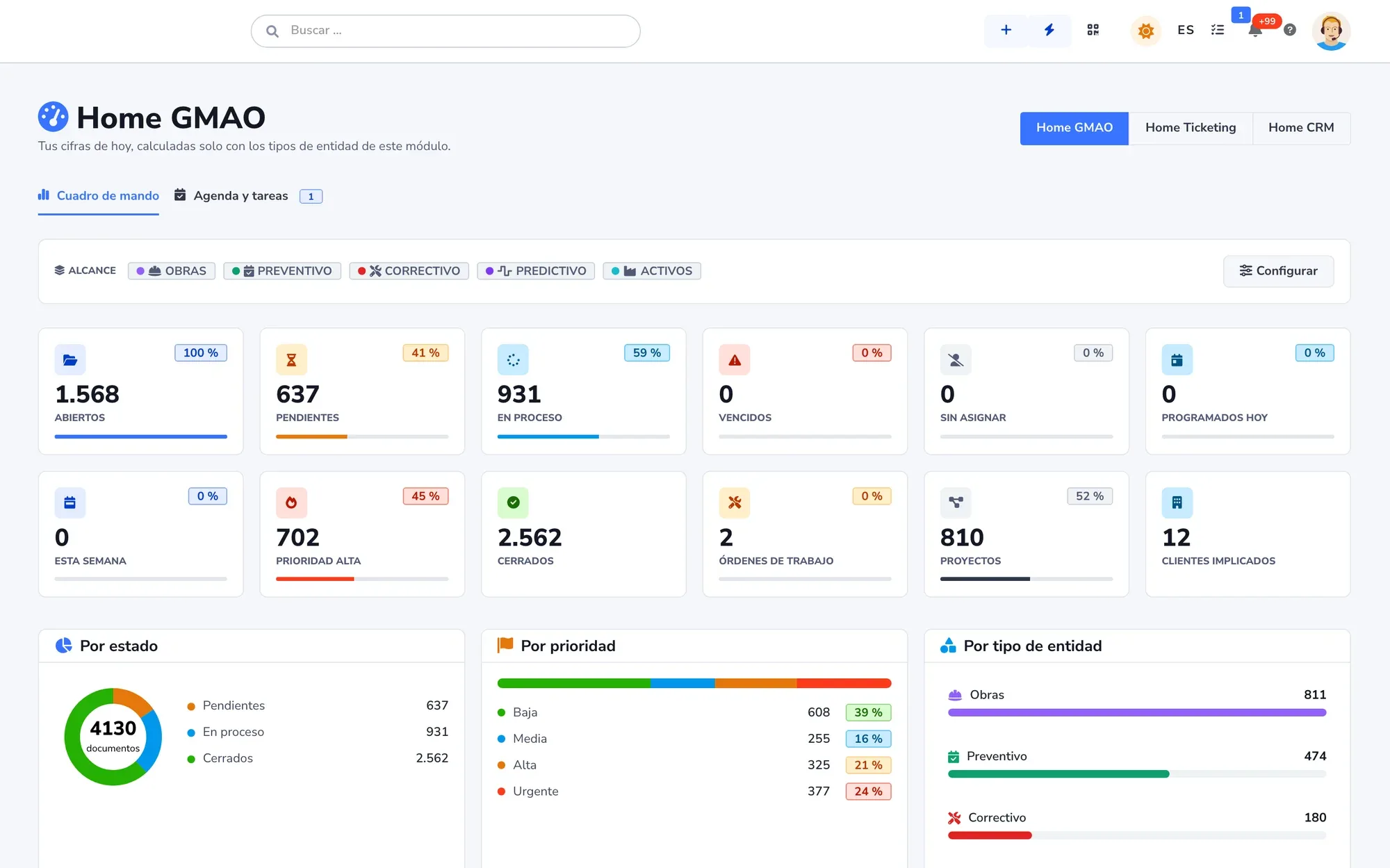
Dashboards and reports by site, building or contract: what is open, what is overdue, SLA compliance and the rating of each job.
With your data
See it with your own sites
In the demo we walk through this workflow with two or three of your sites, some of their equipment and one of your suppliers, not a generic example.
Requests
Every site reports to the same place
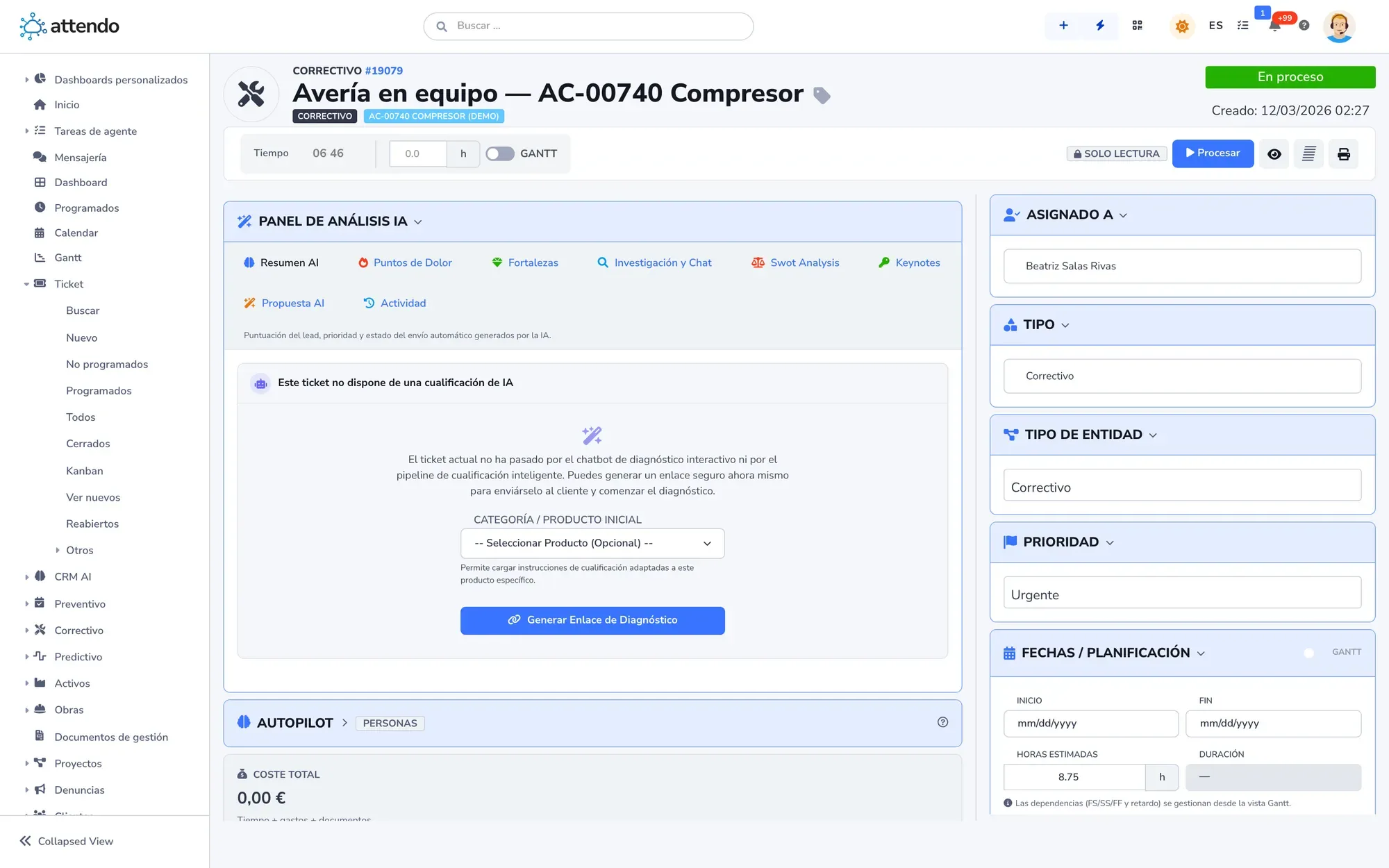
No matter where it comes from, the request is one and the same, and it knows which site, which floor and which equipment it belongs to. The office sees everything open in one queue, with its priority and its deadline.
Receiving and organizing requests is the job of attendo Ticketing, the platform’s help desk.
- A portal for each site: it opens its requests, tracks them and sees its equipment with its warranty and next preventive visit
- A QR code on every asset or room: whoever is there reports with no username or password
- Email and WhatsApp open the request too, with the conversation inside
- Groups up to five levels deep: head office sees every site and opens requests on their behalf, and each site sees only its own
- A page to follow the status of a request without logging in to the portal
- SLAs counted on each contract’s business calendar
Assets
Every site knows what equipment it has
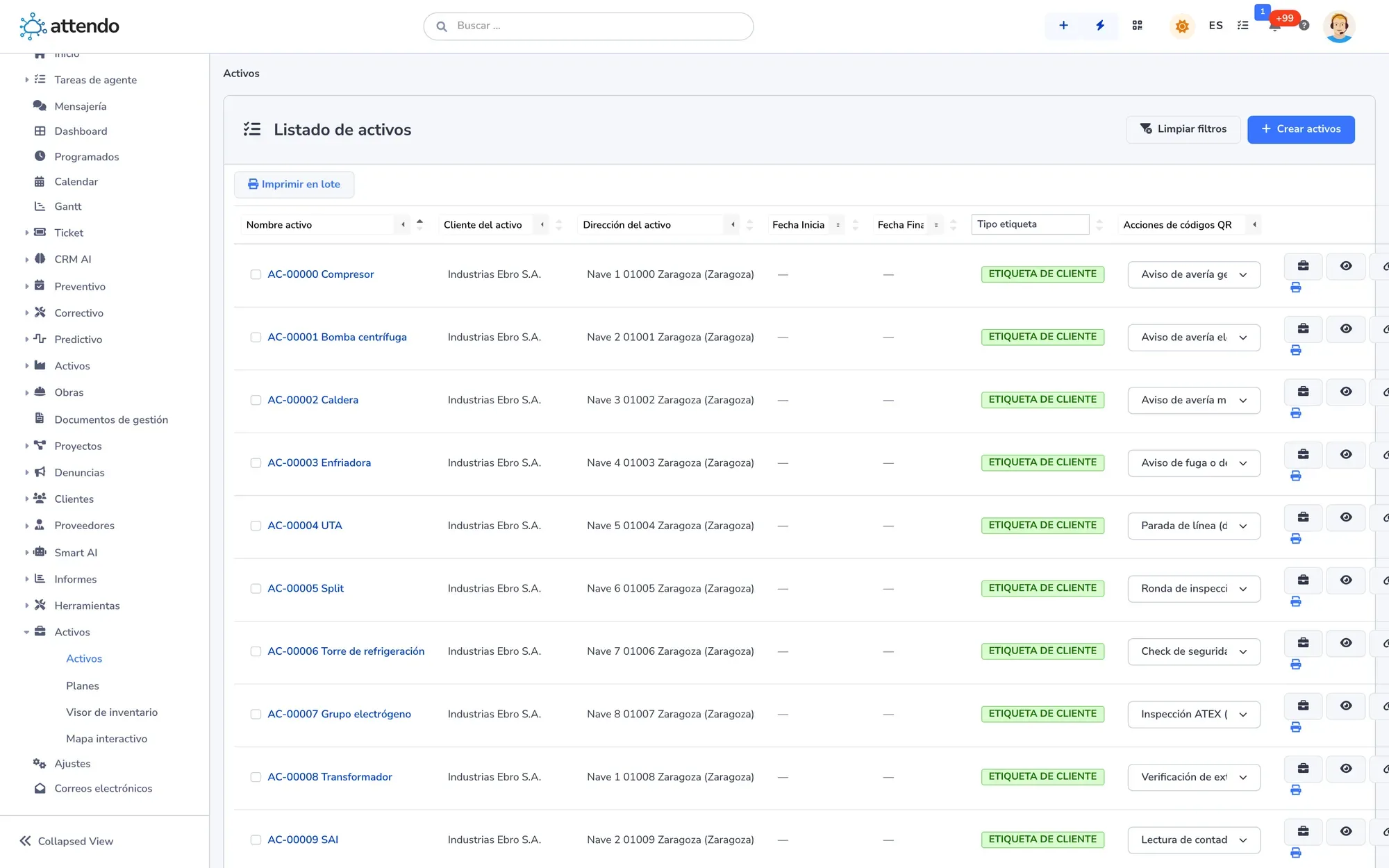
HVAC, elevators, generators, fire protection or walk-in coolers: every asset with its record, its exact location and its history.
Before heading out, your technician knows what was done last time. And if you change suppliers, the inventory stays with you.
- Hierarchy of site, building, floor, room and equipment
- Several QR codes and barcodes per asset, with labels you print in batches
- Folders by building and floor, each with its floor plan and the assets placed on it
- Asset families with their own technical fields, and an alert before a warranty expires
- Import from Excel or CSV, site by site, with the file checked in full before saving
Preventive maintenance
Each site’s preventive maintenance, on its due date
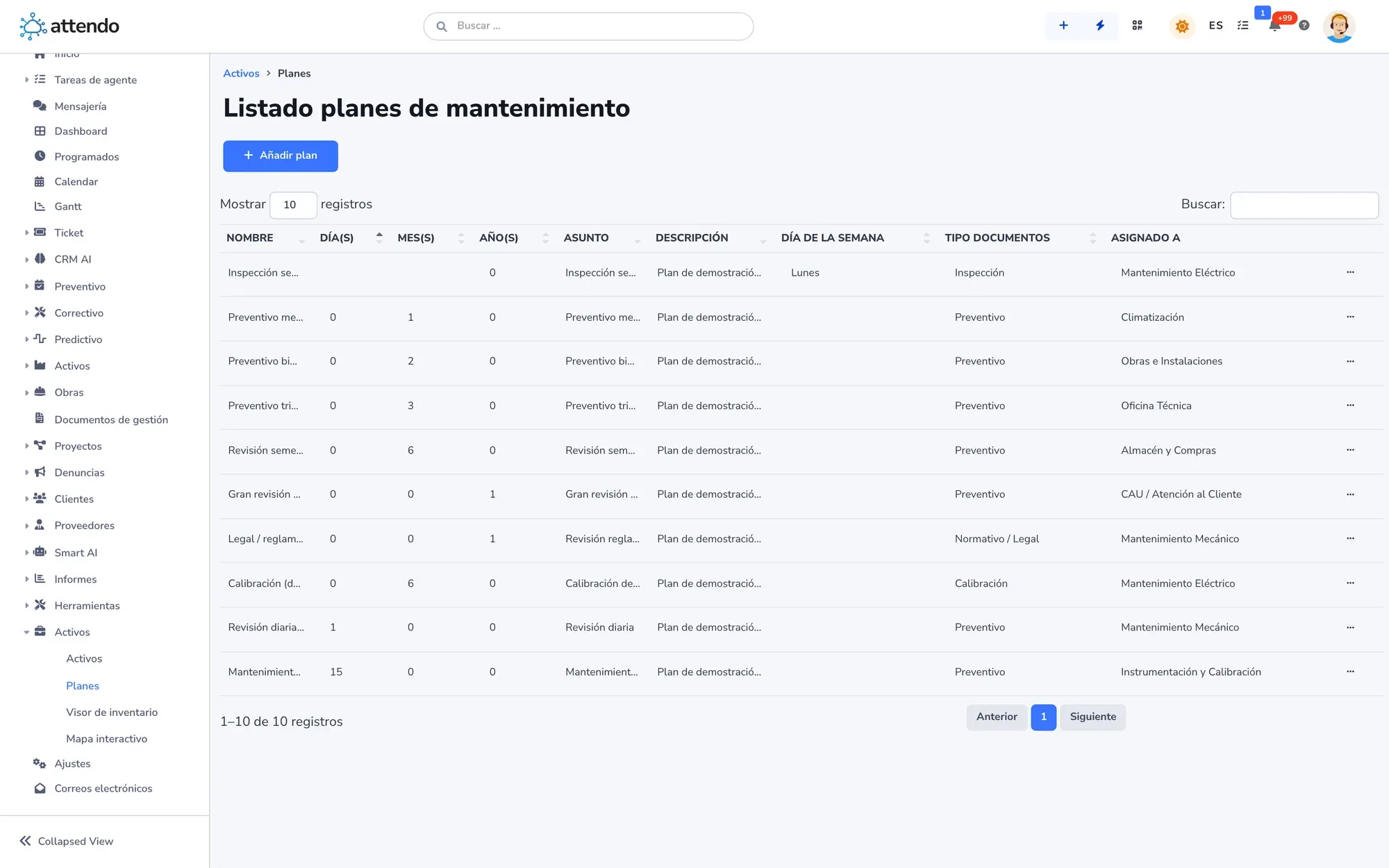
HVAC, fire protection, electrical or elevators: each inspection with its plan and its checklist.
If a supplier does the inspection, the job is assigned to them and they close it in their portal, with their service report.
- Plans by asset, by family or by site, with their checklist
- Work orders generate themselves on the business calendar
- Execution window: how many days an inspection can move without a breach
- Plan tracking: planned versus done, site by site
- Mandatory inspections set up as plans, with their frequency
Suppliers and SLAs
Suppliers with their portal, their SLA and their rating
Cleaning, security, HVAC or elevators: each supplier receives its jobs in its portal, with its contract’s SLA.
What they close stays in the site’s history, just like your own team’s work. So you compare suppliers with data, not impressions.
- Supplier portal: each subcontractor accepts or declines the job, proposes a date and closes it with the customer’s signature, with no license
- Each supplier’s documents, with their expiration date: an agent reviews them and the supplier is warned before they expire
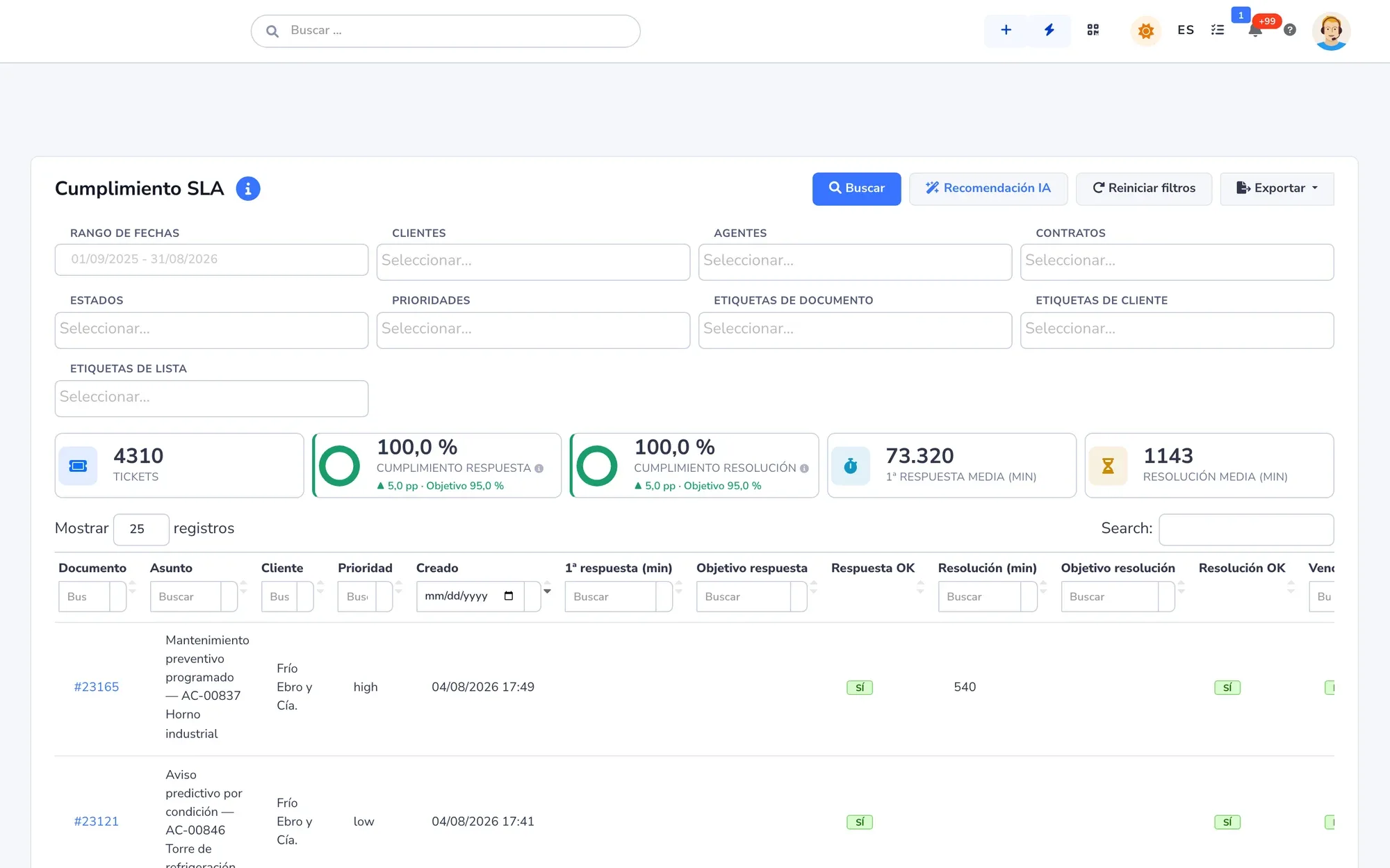
- Each contract’s SLA, measured request by request
- A service report with photos and the date of every job, in the site’s history
- The site rates each job when it is closed
- Reports that compare times by supplier
Documentation and reports
What you are asked for, already on each site’s record
| What you are asked for | How attendo covers it |
|---|---|
| Evidence of every job | Date, time, author, location, photos and signature, with the document locked on close |
| Documentation for each asset and each site | Manuals, certificates and reports in the document manager, attached to their record |
| Mandatory inspections | Plans and checklists with their frequency, set up with your responsible technician |
| Maintenance contracts for each site | Scope, SLA and hour bank in the contract, which the request inherits when it opens. What expires in 30, 60 or 90 days, in one list |
| Your suppliers’ documents | Requested, stored with their expiration date and reviewed, with a warning before they expire. It does not certify contractor safety coordination |
| The site report for management | Dashboards by site, building or contract, with export and scheduled email delivery |
| What it costs to maintain each building | Hours, spare parts and expenses added up on each asset, with the cost per asset, per family and per site |
marIA across your sites
Urgent things first, at every site
-
Prioritizes requests
It proposes an urgency score based on the equipment, the site and what the person reporting says. A person decides.
-
Ask about your sites
“Which sites had the most HVAC requests this month?” It answers with your data, read-only, and shows the query.
-
Summarizes a site
What is open, the pending preventive work and the suppliers who are slow, in one paragraph, before the visit.
What it does not do: assign suppliers or close requests: a person decides. Without AI, everything works the same.
What it covers and what it does not
Where it fits (and where it does not)
Better to know before the demo than at the third meeting.
| If you are looking for… | attendo for facility management |
|---|---|
| Requests, assets, preventive maintenance and suppliers across several sites | attendo for facility managementThis is its home turf |
| Maintaining customers’ equipment under contract, as a maintenance company | attendo for facility managementThat too: see Facility maintenance and services |
| Managing space and workstations, room booking or leases | attendo for facility managementIt does not do that: it is not an IWMS. You will need another tool |
| Energy management or building BIM models | attendo for facility managementNot that either. Sensors do connect, and an out-of-range reading opens a work order |
Solutions and modules it uses
Not another product: attendo with these solutions
You turn them on step by step and they work on the same record: the site, the asset and the supplier are the same in all of them.
Platform modules involved
After you request a demo
What happens when you get in touch
A real person from our team replies, and we prepare the demo around your case. No cold calls afterwards.
When we reply
Our hours: Monday to Thursday 9:30 AM to 6:30 PM and Friday 9:30 AM to 2:30 PM, Spain time.
We have emailed you a confirmation that your request arrived. If you do not see it in a few minutes, check your spam folder.
- Today
You tell us about your case
What you want to solve, how many people would use it and what you work with now.
- Next
We agree on a time
We write to you to schedule the demo and, if you like, to ask for a sample of your data: the list of your sites, some of their equipment and how issues reach you today.
- In the demo
You see attendo with your own setup
Your document types, your assets and your customers. And we tell you what fits and what does not.
Frequently asked questions
Frequently asked questions
Is it an IWMS?
No. attendo does not manage space or workstations, room booking, leases or energy. It covers maintenance and services at each site: service requests, assets, preventive maintenance, suppliers, SLAs and documentation.
How do people at a site report an issue?
Whichever way is easiest for them: from the portal, by scanning the QR code on the equipment or in the room with no username or password, by email or by WhatsApp. The request arrives with the site already identified.
Can my suppliers work in attendo?
Yes, through the supplier portal. Each supplier accepts or declines its jobs, logs hours and materials, closes them with the customer’s signature and sees only its own work. It also uploads the documents you require, with their expiration date: expired ones warn you, but do not stop you from assigning work. Portal users do not count as licenses.
Can my sites see their equipment and floor plans?
Yes, if you turn it on. In their portal, each site sees its equipment with the warranty and the next preventive visit, reports a breakdown from there and views the floor plans of its locations, read-only and with its own items only.
Can I see the data by site?
Yes. Dashboards and reports can be filtered by site, building, contract or line of business, and you can schedule them to go out by email.
Can I start with just a few sites?
Yes. You can start with one region or one type of building, with its inventory and its suppliers, and add the rest later without migrating anything.
How is it different from Ticketing, the CMMS or Field Service?
It is not another solution: it is attendo with Ticketing for service requests, the CMMS for assets and preventive maintenance, and Field Service if you have your own technicians on the road, plus the portal for sites and suppliers.
Does it connect to my ERP and my building systems?
With your ERP, yes: Odoo, Business Central, SAP Business One and Holded have native connectors, and the invoice is issued by your connected ERP, because attendo is not an ERP or accounting software. Sensors and IoT connect natively, and other systems come in via API or webhook.
Where is the data stored?
In the European Union. attendo runs as SaaS in a European region and, as a project, also on-premise, on your own infrastructure.
Request a demo
Start with two or three sites
We will show you attendo with your sites, some of their equipment and one of your suppliers. If it does not fit your operation, we will tell you.
- With your operation, not a generic demo
- A real person from our team replies
- No cold calls afterwards
Would you rather talk first?
- Phone +34 902 750 677 · +34 910 053 530
- Email sales@attendo.me
- Monday to Thursday 9:30 AM to 6:30 PM and Friday 9:30 AM to 2:30 PM (Spain time)