
Asset AST-0418
Booster pump BP-02
- Family
- Pumping
- Location
- Building 2 · plant room
- Serial no.
- SN-4471-K
- Warranty
- Until Mar 2027
Choose which cookies you accept. You can change this at any time from “Cookie settings” in the footer of every page. Cookie policy
They make the website work, remember this choice, keep your conversation with the assistant if you use it, and protect the forms from bots. They cannot be turned off.
During your visit we remember the campaign source you arrived with and the page you landed on, so we know which campaigns and pages bring us requests. Cloudflare Web Analytics counts visits without cookies and does not depend on this option.
Used to measure our campaigns on Google Ads, LinkedIn and Meta. None is active on the website today.
Customization
Your document types, your fields, your screens, your checklists and your vocabulary. It all lives in configuration, not in custom code. That is why attendo keeps getting updates no matter how much you adapt it.
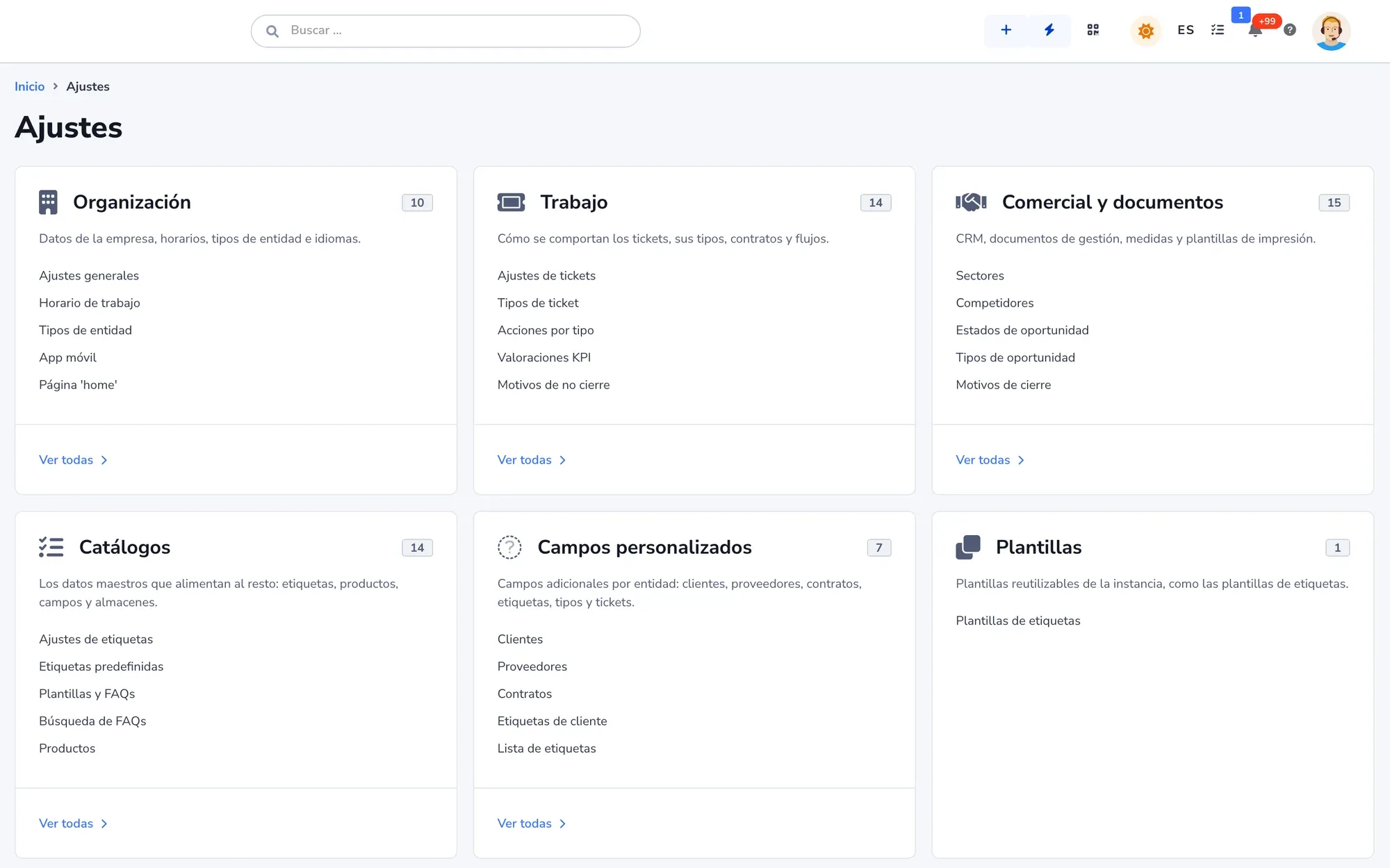
The problem
Rigid software forces you to change your process to fit it. Custom-built software fits on day one, breaks with every update and depends on whoever built it. attendo takes a third path: it is configured, not programmed.
Configuration
Document types
A ticket, a work order, a case file or a construction job. Each type has its own menu, icon, color, fields and workflow.
You choose which blocks appear on the record and in what order, and which views it uses: table, board or calendar. The screen is composed, not coded.
Ticketing, Customer Service, CRM, After-Sales, Field Service, CMMS, Projects, Compliance and Flows each come with their home screen with KPIs, their reports and a dashboard you can edit. You can also create your own areas with their name, icon and home screen.
On a single screen you decide which menu, home screens, dashboards and reports each person sees, and which options are hidden from them. For desktop, tablet and mobile.
Custom fields with permissions by role, required when needed, and visible, read-only or hidden in each portal. Lists filter by any of them.
Several companies, work groups, business lines, workspaces and industries in the same instance. Each person works in the ones that concern them, with each company’s or line’s branding.
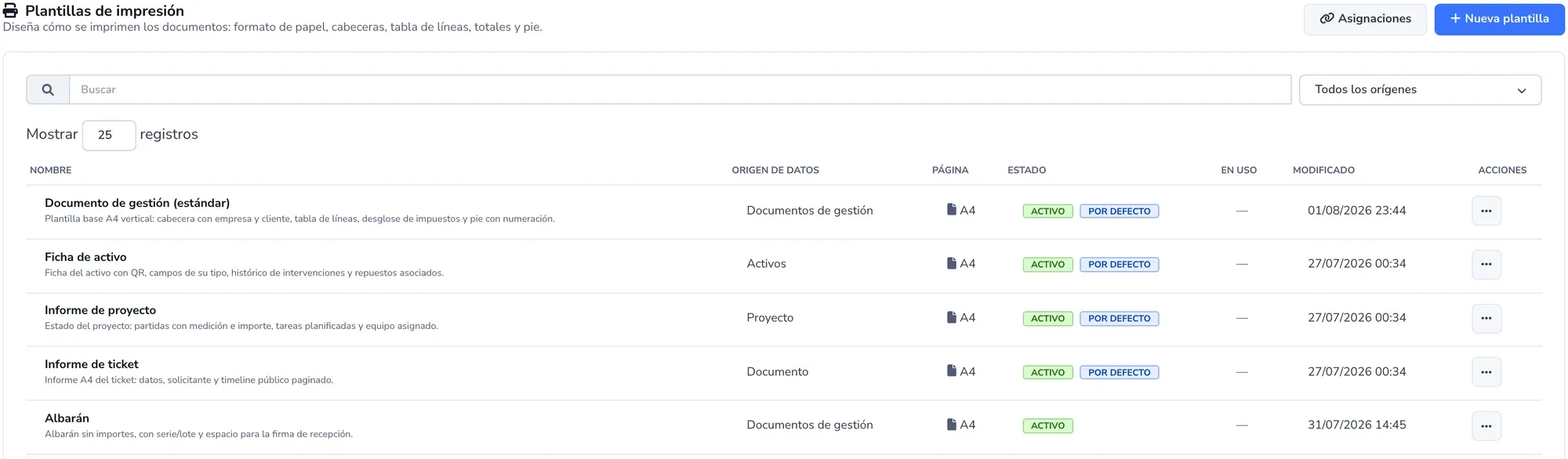
You design your labels like the rest of the templates: format, fields and QR code or barcode. And process and flow diagrams adapt to your operation.
A page the team writes at the same time, showing who wrote each part and what changed, with versions. Or a canvas to draw on together over a photo or a floor plan. Linked to documents, customers, projects, people and groups.
Tags
A piece of equipment, a customer or a location has its own fields, what is linked to it, the documents opened on it and a template that can be copied to another customer. Pick a solution and look at the four layers.
Example What’s behind a tag
01 · Information
It has its own record
The equipment tag keeps its fields: the built-in ones and any you add.
Booster pump BP-02
01 · Information
It has its own record
The equipment tag keeps its fields: the built-in ones and any you add.
Front desk printer
01 · Information
It has its own record
The installed equipment tag keeps its fields: the built-in ones and any you add.
Rooftop air handler
01 · Information
It has its own record
The equipment tag keeps its fields: the built-in ones and any you add.
Building boiler
01 · Information
It has its own record
The appliance tag keeps its fields: the built-in ones and any you add.
Built-in dishwasher
02 · Relationships
It’s linked
The customer who owns it and the maintenance plan: they open from the tag itself, with no searching.
02 · Relationships
It’s linked
The customer and the contract with its SLA: they open from the tag itself, with no searching.
02 · Relationships
It’s linked
The account and the contract that is up for renewal: they open from the tag itself, with no searching.
02 · Relationships
It’s linked
The customer and the area technician: they open from the tag itself, with no searching.
02 · Relationships
It’s linked
The consumer and the manufacturer that covers the warranty: they open from the tag itself, with no searching.
03 · Context
It builds up what happens
Every work order opened on the equipment stays in its history: who, when and what was used.
Corrective WO · WO-2026-0142
Vibration and seal leak
In progressLinked to
AST-041803 · Context
It builds up what happens
Every ticket that comes in about the equipment stays in its history: who, when and what was used.
Ticket · TK-2026-0311
Network printing down since yesterday
In progressLinked to
EQ-120703 · Context
It builds up what happens
Every opportunity opened on the equipment stays in its history: who, when and what was used.
Opportunity · OP-2026-0057
Extend the contract to the second location
ProposalLinked to
AST-095203 · Context
It builds up what happens
Every service report signed on the equipment stays in its history: who, when and what was used.
Service report · SR-2026-0873
Annual boiler service
SignedLinked to
AST-221003 · Context
It builds up what happens
Every repair request on the appliance stays in its history: who, when and what was used.
Service request · TK-2026-1954
Won’t drain at the end of the cycle
Waiting for partsLinked to
AP-553104 · Template
It copies in full
A tag template carries fields, links and tasks over to another customer in one go.
Booster pump
New tag for CU-0307
04 · Template
It copies in full
A tag template carries fields, links and tasks over to another customer in one go.
Multifunction printer
New tag for CU-0112
04 · Template
It copies in full
A tag template carries fields, links and tasks over to another customer in one go.
Rooftop air handler
New tag for CU-0533
04 · Template
It copies in full
A tag template carries fields, links and tasks over to another customer in one go.
Building boiler
New tag for CU-0671
04 · Template
It copies in full
A tag template carries fields, links and tasks over to another customer in one go.
Built-in dishwasher
New tag for CU-8840
Checklists and templates
Free-form checklists with photos, QR codes, geolocation, range alerts, conditional logic and versions. Task templates by type. And a print designer where you drag fields to build your quote, your service report or your delivery note, with QR codes and barcodes.
If your team says “case file”, attendo says “case file”. You rewrite any text or change a term across a whole language, with a preview. After each update, a glossary flags new texts that use the standard word. The portals also have their own words. Spanish, English and Catalan come standard, and you can add languages.
Logo, colors, font and legal footer by company, business line or issuing company. Emails, web quotes, payment pages and portals go out with the brand of whoever issues them.
You turn on only what you need, and the rest takes up no space in the menu. Settings have a search box and each screen explains what it is for.
marIA
Translates missing text into another language and never overwrites what a person wrote.
Draws the flow you describe in plain language.
See automationEvery marIA operation is logged with its cost, and spending stops at the cap you set. See how AI is controlled
Onboarding
Implementation follows a step-by-step onboarding wizard, with the questions that define your operation. The result is a template that is simulated before it is applied and never overwrites what already exists.
Limits
Configuration is not done by API: it is done in the settings, on desktop.
Critical administration screens are protected with step-up verification. Your implementation partner handles them.
Document history from another program is not imported automatically. It is scoped as a project.
The rest of the platform
Frequently asked questions
No. The configuration lives in data, not in modified code. A heavily customized instance updates just like a standard one.
Not for document types, fields, screens, checklists, printing or flows.
No. Your administrator handles day-to-day configuration. Only the critical screens, such as module activation or the flow editor, need your partner.
It is modular. You start with one area, each profile sees only its part and what you do not use does not appear.
Yes. You change any term across the whole platform, with a preview.
Yes. From Settings you download the template for each item, fill it in and validate it: validation saves nothing and returns the errors row by row. Whatever you export can be imported back as is.
No. Each solution, such as CMMS or Customer Service, is the same engine with that work’s home screen, reports and dashboard. You turn on the ones you subscribe to, and one person can have several and choose their own.
Request a demo
Tell us about your ticket types, your inspections and your documents, and we will show you attendo with your vocabulary and your brand.
Would you rather talk first?